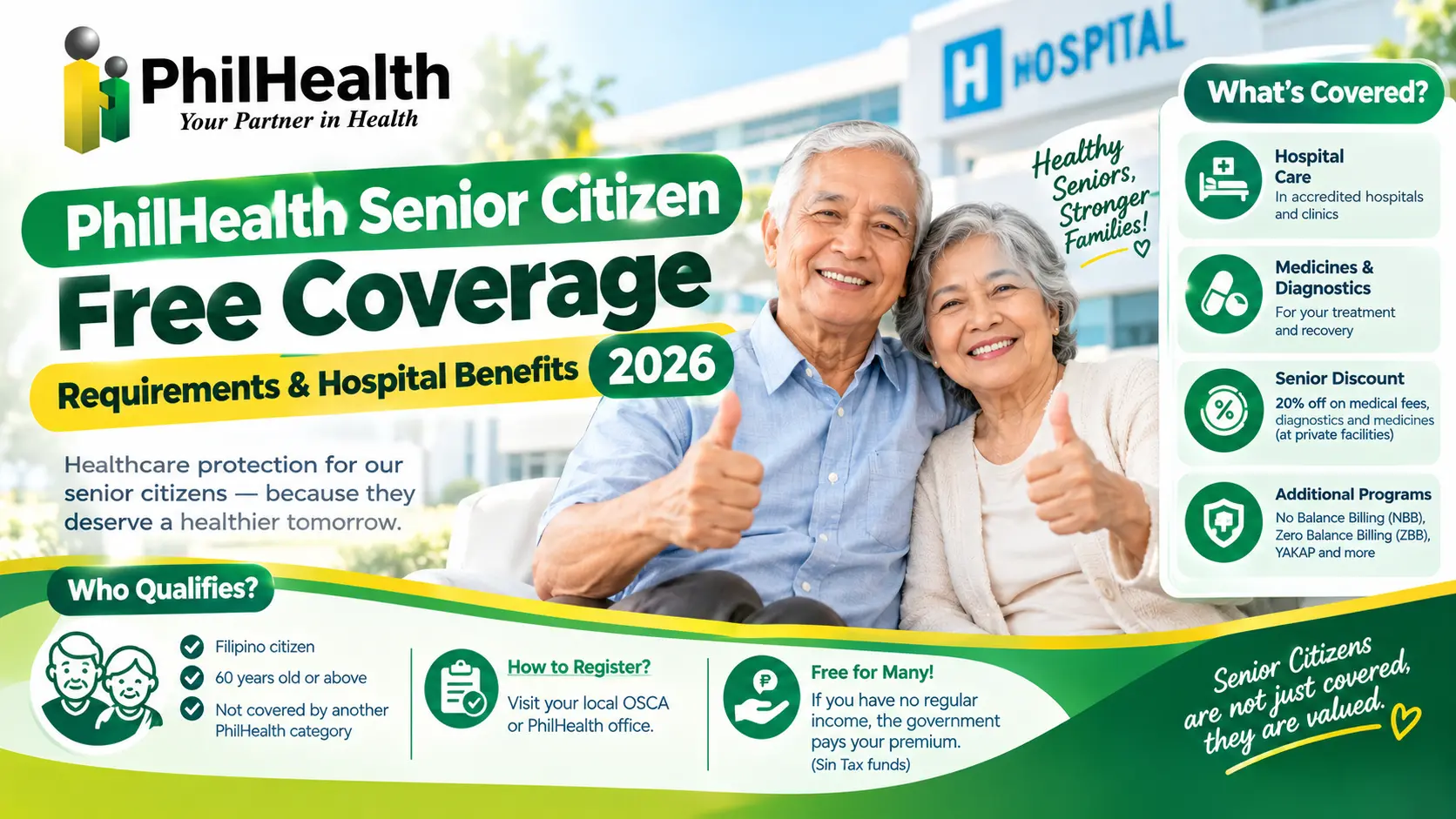
PhilHealth Senior Citizen Free Coverage Requirements & Hospital Benefits 2026
Your father is 68. He’s admitted to a private hospital with pneumonia. You tell yourself, “Don’t worry. He’s a senior. PhilHealth covers him.”
Then the billing desk hands you a statement. The balance is bigger than you expected. Nobody can explain why. Many families think PhilHealth senior citizen coverage works like magic. It doesn’t. It has rules. And small mistakes can cost thousands of pesos.
This guide shows how a PhilHealth senior citizen gets covered, registers, and reads the hospital bill. You’ll also learn two things most families miss:
Quick Answer
Is PhilHealth free for senior citizens? Yes, many senior citizens can get PhilHealth coverage without paying premiums themselves. Filipinos aged 60 and above who are not covered under another membership category may qualify, with the government paying their premiums. But seniors who still have regular income keep paying under their own category. To register, go to your local OSCA or PhilHealth office.
What Is PhilHealth Coverage for Senior Citizens?
PhilHealth senior citizen coverage is health insurance that the law gives to Filipinos aged 60 and above. It comes from RA 10645.
The Universal Health Care Law (RA 11223) says the same thing. So PhilHealth senior citizen coverage is not a favor. It’s a legal right.
Automatic Doesn’t Mean Activated
The law covers your parent at 60. But there’s a catch. Every PhilHealth senior citizen still needs to register.
Why? Registration gives them two things:
- A PhilHealth Identification Number (PIN)
- A Member Data Record (MDR)
Hospitals use these to check coverage. PhilHealth itself urges seniors to make sure they are registered and that their records are up to date.
PhilHealth Senior Citizen Member vs. Other Members
PhilHealth counts several kinds of members. Here’s how they differ.
Member type | Who they are | Who pays the premium |
|---|---|---|
Senior Citizen member | Aged 60 and above, not covered by another category | The National Government (Sin Tax funds) |
Lifetime member | Usually a retiree who completed the required contributions (verify) | No more premiums (verify) |
Regular member (employed or self-paying) | People who work or earn income | The member, plus the employer if employed |
Who Qualifies as a PhilHealth Senior Citizen?
To be a PhilHealth senior citizen member, you must be:
The Income Rule
PhilHealth’s page says seniors who are employed or still have regular sources of income continue to pay their premiums under their own category.
So a PhilHealth senior citizen who still earns a regular income isn’t “free.” They keep paying, just like other members.
Who Qualifies and Who Doesn’t
Likely qualifies | Needs a closer look |
|---|---|
A senior with no PhilHealth coverage and no regular income | A senior who is still employed or has regular income |
A senior who is a dependent of a Senior Citizen member | A senior already covered under another category |
A senior parent declared as a dependent by a member | A senior who isn’t sure whether their pension counts as regular income |
Do Senior Citizens Pay PhilHealth Premiums?
A PhilHealth senior citizen with no other coverage and no regular income doesn’t pay premiums. The National Government pays them, using Sin Tax money (RA 10351).
But a senior who is still working or earns regular income keeps paying under their own category. PhilHealth’s senior page says so directly.
Health Insurance for Senior Citizens in the Philippines
PhilHealth is the foundation of health insurance for senior citizens in the Philippines. But it isn’t the only protection. A senior can have several layers at once.
Layer | What it is | Where it applies |
|---|---|---|
1. PhilHealth benefit | Insurance that pays your claim | Accredited hospitals and clinics |
2. Senior discount (RA 9994) | 20% discount plus VAT exemption | Private hospitals, clinics, and home health care |
3. No Balance Billing (NBB) | PhilHealth policy since 2011, mainly for indigent and sponsored members | Public accredited hospitals, service settings |
4. Zero Balance Billing (ZBB) | No out-of-pocket cost for ward patients | DOH-run hospitals, basic or ward beds |
5. YAKAP primary care | Check-ups, lab tests, and medicines | Accredited YAKAP clinics |
6. Private insurance or HMO (optional) | Extra coverage you buy | Depends on the plan |
Layer 1: The PhilHealth Benefit
This is insurance. It pays a set amount to the hospital on your behalf. We explain how in the hospitalization sections.
Layer 2: The 20% Senior Discount
This comes from a different law, RA 9994. It’s not insurance. It’s a required price reduction. It applies to medical fees, diagnostics, and medicines at private facilities, and it applies whether or not you’re a PhilHealth member.
You’ll often hear it called “28.6%.” Here’s where that number comes from.
Step | Price |
|---|---|
Price with VAT | ₱1,120 |
Remove the 12% VAT | ₱1,000 |
Take 20% off | ₱800 |
You save | ₱320, about 28.6% |
Layer 3: No Balance Billing (NBB)
PhilHealth started NBB in 2011. It applies mainly to indigent and sponsored members in PhilHealth-accredited public hospitals.
Layer 4: Zero Balance Billing (ZBB)
ZBB is bigger and newer. Under it, all patients, regardless of economic status, no longer pay out of pocket when admitted to the basic ward of any of the 87 DOH-run hospitals. PhilHealth pays what it can, and the DOH covers the rest. The DOH said the government shouldered ₱95 billion in hospital bills from July 2025 to January 2026 under ZBB, benefiting about 1.6 million patients.
Layer 5: YAKAP Primary Care
This is PhilHealth’s check-up and medicines package. We cover it in the section on what PhilHealth pays.
Layer 6: Private Insurance or HMO
Some seniors add private coverage. Age limits and conditions vary by plan, so check with the insurer.
How to Register for PhilHealth as a Senior Citizen
Remember, the law covers your parent at 60. But registration makes the coverage usable. There are two official paths.
Path 1: Through the OSCA
The OSCA is the Office for Senior Citizens Affairs in your city or municipality.
Path 2: Through a PhilHealth Local Health Insurance Office (LHIO)
This is PhilHealth’s own office.
Questions | OSCA | LHIO |
|---|---|---|
Where | The OSCA where the senior lives | Any PhilHealth Local Health Insurance Office |
What to bring | Completed PMRF | Completed PMRF, a 1×1 photo taken within the last six months, and a Senior Citizen ID or a valid government-issued ID |
What you get | Member Data Record (MDR) and ID card, issued through the OSCA | MDR and PhilHealth ID card |
Best for | Seniors who also need their Senior Citizen ID | Seniors who already have an ID |
How Many PMRF Copies?
PhilHealth’s senior page says to submit one PMRF at the OSCA. But a PhilHealth press release says two. So print two copies to be safe.
Step by Step
- Get the PMRF. Download it from philhealth.gov.ph, or ask at the OSCA or LHIO. It’s free.
- Fill it out in capital letters. Use the name as shown on the birth certificate, and write “N/A” for items that don’t apply.
- Tick the right boxes. The purpose is Registration. For member type, choose Senior Citizen under the indirect contributors.
- Sign it. If the senior can’t write, use a right thumbprint.
- Prepare the extras. At an LHIO, add the 1×1 photo and the Senior Citizen ID or a valid government ID.
- Submit it at the OSCA or LHIO.
- Wait for the MDR and PhilHealth ID. The OSCA will notify the senior.
- Keep copies. Take photos of the MDR and ID.
What If the Senior Can’t Travel?
A trusted family member can submit the PMRF. They should bring a signed authorization letter, a copy of the senior’s valid ID, and their own valid ID.
[Date]
The Office for Senior Citizens Affairs / PhilHealth LHIO
[Office name and address]
Subject: Authorization to Submit PhilHealth Registration for a Senior Citizen
Dear Sir/Madam:
I, [Senior’s Full Name], [age] years old, residing at [Address], cannot go to your office in person because [reason, for example: I have difficulty traveling due to my health].
I authorize my [relationship], [Representative’s Full Name], to submit my PhilHealth Member Registration Form (PMRF) and receive my Member Data Record and PhilHealth ID on my behalf. His/her details are:
Complete address: [Address]
Contact number: [Number]
Valid ID presented: [ID type and number]
Copies of my valid ID and my representative’s valid ID are attached.
Respectfully yours,
[Signature]
[Printed Name]
[Contact Number]
Conforme:
[Representative’s Signature over Printed Name] Date: [Date]
What PhilHealth Pays for Senior Citizens
You’re registered. So what does a PhilHealth senior citizen actually get?
The Main Benefits
Benefit | What it is | Where |
|---|---|---|
Hospitalization (case rates) | A fixed amount PhilHealth pays for an illness or procedure | PhilHealth-accredited hospitals |
YAKAP primary care | Check-ups, lab tests, cancer screening, and medicines | Accredited YAKAP clinics |
Qualified dependents | Coverage for eligible dependents | Same facilities |
One Rule Before You Go
PhilHealth benefits work at accredited hospitals and clinics. Before admission, ask: “Is this facility PhilHealth-accredited?”
Now for the main event. What does the hospital actually deduct from the bill? And what happens when the hospital is private? That’s where families get surprised.
Senior Citizen PhilHealth Hospitalization Coverage
Now let’s open the bill. This is where senior citizen PhilHealth hospitalization coverage turns into real pesos.
What Is a Case Rate?
A case rate is a fixed amount PhilHealth pays for a specific illness or procedure. Pneumonia has one amount. An operation has another. The amount covers hospital charges and the doctor’s fees. PhilHealth’s circular says the benefit includes the professional fees.
PhilHealth’s circular says case rates and benefit packages are paid in full, regardless of the senior citizen discount. In plain words: getting the 20% discount doesn’t shrink PhilHealth’s payment. You get both.
How the Hospital Checks Your Coverage
Many hospitals use a system called the HCI Portal. Here’s how it works for a PhilHealth senior citizen, according to PhilHealth’s senior page.
- You show your senior citizen card, MDR, or another accepted proof of identity and age.
- The hospital prints a PhilHealth Benefit Eligibility Form (PBEF).
- If the PBEF says “YES,” you’re entitled to benefits. That’s the basis for automatic deduction from your bill.
Enrolling at the Hospital
What if the hospital has no portal? What if the PBEF says “NO”? What if your parent couldn’t enroll before discharge?
PhilHealth’s page says you can still go ahead. Attach these two things to the usual claim documents:
What to Ask the Hospital Before Admission
Question | Why it matters |
|---|---|
Are you PhilHealth-accredited? | Benefits work only at accredited facilities |
Do you have an HCI Portal, and can you print a PBEF? | It confirms automatic deduction |
Can I see your room, medicine, and lab price list? | PhilHealth’s circular requires accredited hospitals to post their rates in places like the admitting, ER, and billing sections |
Will my statement of account show the VAT exemption, the 20% discount, and the PhilHealth deduction? | PhilHealth’s circular says each deduction should appear on the statement |
Who handles senior citizen complaints? | The circular says hospitals must set up a grievance desk |
Senior Citizen PhilHealth Hospitalization Coverage in a Private Hospital
A private hospital can give you strong PhilHealth senior citizen hospitalization coverage. But it works differently than a government ward. Let’s see how.
Public vs. Private: The Big Difference
# | Public hospital (ward) | Private hospital |
|---|---|---|
PhilHealth benefit | Yes, at accredited facilities | Yes, at accredited facilities |
20% senior discount and VAT exemption | Yes | Yes |
Balance after deductions | PhilHealth says seniors admitted to public facilities pay nothing under No Balance Billing | A balance may remain, and you pay it |
Zero Balance Billing (ZBB) | Yes, in DOH-run hospitals, basic or ward beds | No |
The Order of Deductions
PhilHealth’s own circular says the hospital must deduct in this order:
- 12% VAT exemption from the total charges
- 20% senior citizen discount from what remains
- The PhilHealth benefit from what remains after that
What’s left is your co-payment.
PhilHealth repeated this in its 2023 advisory. Its president said the balance is the only amount the patient should pay. He also said patients can check this on their billing statements.
Same Bill, Two Different Totals
Does the order really matter? Let’s use PhilHealth’s own pneumonia example. The case rate is ₱15,000, and the total hospital bill is ₱35,000.
Step | Correct order (PhilHealth’s rule) | Wrong order (PhilHealth first) |
|---|---|---|
Total hospital charges | ₱35,000 | ₱35,000 |
PhilHealth benefit | ₱0 | ₱15,000 → ₱20,000 |
12% VAT exemption | ₱4,200 → ₱30,800 | ₱2,400 → ₱17,600 |
20% senior discount | ₱6,160 → ₱24,640 | ₱3,520 → ₱14,080 |
PhilHealth benefit | ₱15,000 | (already deducted) |
You pay | ₱9,640 | ₱14,080 |
What Your Statement of Account Should Show
Before you pay, look for these lines.
Line | What it means |
|---|---|
Total hospital charges | Everything billed, including professional fees |
VAT exemption (12%) | Deducted first |
Senior citizen discount (20%) | Deducted second |
PhilHealth benefit | Deducted third |
Balance / co-payment | What you owe, if anything |
Hospital Didn’t Apply the Discount?
Hospitals that don’t apply these discounts can face penalties, including fines and even suspension or revocation of accreditation. You can report a missed deduction to:
Documents to Bring to the Hospital
A little preparation avoids a lot of stress. Here’s what to bring.
Document | Why you need it | Notes |
|---|---|---|
PhilHealth ID or MDR | Shows your PIN and membership | Take photos as a backup |
Senior Citizen ID (from the OSCA) | Proof of age and senior status | Also used for the 20% discount |
A valid government ID | Confirms who the patient is | Bring the original |
Completed PMRF, if not yet registered | Lets the hospital enroll the senior | Attach it to the claim documents |
Proof of senior status, if not yet registered | Needed together with the PMRF | The Senior Citizen ID is accepted |
Claim forms from the hospital | Needed to file the claim | Usually handled by the hospital’s PhilHealth desk |
An authorization letter, if a family member will sign | Shows the member allowed someone to act | See our guide below |
The Claim Signature Form
Hospitals usually hand you a form to sign for the PhilHealth claim. It’s called the Claim Signature Form (CSF). A family member can sign for a senior who can’t, if they tick the right boxes.
Printable Final Checklist
Before registering
Registration papers
Before any hospital admission
At billing, before discharge
FAQs
Is PhilHealth free for senior citizens?
Yes, a senior aged 60 or above who is not covered by another PhilHealth category and has no regular income is covered under RA 10645, and the National Government pays the premium from Sin Tax funds. Seniors who are still employed or have regular income keep paying under their own category.
Do senior citizens who still work have to pay?
Yes, PhilHealth’s senior page says seniors who are gainfully employed or have regular sources of income continue to pay their premiums under the applicable membership category.
At what age do you become a PhilHealth senior citizen?
At 60 years old. A PhilHealth senior citizen is a Filipino citizen who lives in the Philippines and is aged 60 or above.
Do I need to register, or is it automatic?
The law covers senior citizens automatically, but you should still register. Registration gives you a PhilHealth Identification Number (PIN) and a Member Data Record (MDR), which hospitals use to check coverage. PhilHealth urges seniors to make sure they are registered and that their records are up to date.
What documents do I need to register?
Through the OSCA, submit a completed PMRF. PhilHealth’s senior page says one copy, while a PhilHealth press release says two, so bring two to be safe. Through a PhilHealth LHIO, bring a completed PMRF, a 1×1 photo taken within the last six months, and a Senior Citizen ID or a valid government-issued ID.
Does PhilHealth cover senior citizens in private hospitals?
Yes, at PhilHealth-accredited private hospitals. The PhilHealth benefit and the 20% senior discount both apply. But Zero Balance Billing does not apply to private hospitals, so a balance may remain and you pay it.
Is the 20% discount applied before or after PhilHealth?
Before. PhilHealth’s circular and advisory say the hospital deducts the 12% VAT exemption first, then the 20% senior citizen discount, then the PhilHealth benefit. What remains is the co-payment.
What is No Balance Billing or Zero Balance Billing, and does it apply to private hospitals?
No Balance Billing is a PhilHealth policy from 2011, mainly for indigent and sponsored members in accredited public hospitals. Zero Balance Billing means patients admitted to basic or ward beds in DOH-run hospitals pay nothing out of pocket. Neither program covers private hospital rooms in general.
What’s the difference between the PhilHealth benefit and the senior discount?
The PhilHealth benefit is insurance that pays your claim. The senior discount under RA 9994 is a required price reduction of 20% plus VAT exemption. They are separate, and both can apply to the same hospital bill.
Can someone register me if I can’t go?
A trusted family member can usually submit your PMRF with your signed authorization letter, a copy of your valid ID, and their own valid ID. PhilHealth’s senior page doesn’t mention representatives, so ask the OSCA or LHIO to confirm first.
Can I enroll at the hospital before discharge?
Yes. If the hospital has no HCI Portal, the PBEF says “NO,” or the senior wasn’t able to enroll before discharge, a completed PMRF and acceptable proof of senior status can be attached to the usual claim documents.
Do senior citizens need private health insurance too?
PhilHealth and the senior discount may leave a balance at a private hospital. Some seniors add private insurance or an HMO for extra protection. Plans differ, so compare age limits and conditions with the insurer.